

Table of Contents
- What Hair Porosity Actually Means for Your Strands
- 4 At-Home Tests to Identify Your Hair Porosity
- Hair Porosity Float Test Accuracy: What Science Says
- Signs of Low Porosity Hair and How to Care for It
- Signs of High Porosity Hair and How to Care for It
- Best Products for Natural Hair Porosity
- How Porosity Changes Over Time and With the Seasons
- Frequently Asked Questions
Last Updated: September 13, 2026
What Hair Porosity Actually Means for Your Strands
Hair porosity is your hair's ability to absorb and retain moisture, determined by the condition of your cuticle layer. This guide from Kinkistry breaks down how to identify your hair porosity using four at-home tests. Two people with identical curl patterns can need opposite routines: one head of 4C coils drinks up leave-in conditioner, another repels it. The difference isn't curl type, it's the cuticle.
The Cuticle: Your Hair's Gatekeeper
The cuticle is the outermost layer of the hair shaft, made of overlapping scales that control what enters and exits your strands. When those scales lie flat and tight, moisture struggles to get in. When they're raised or damaged, moisture floods in and escapes just as fast. Sebum, your scalp's natural oil, interacts with this layer too, coating the cuticle and slowing water loss. According to the American Academy of Dermatology's overview of hair biology, the hair shaft's condition, not its curl pattern, dictates how it holds moisture. That's the core principle behind everything below.
4 At-Home Tests to Identify Your Hair Porosity
No single test is definitive, so run at least two and compare results. All four take under ten minutes combined.
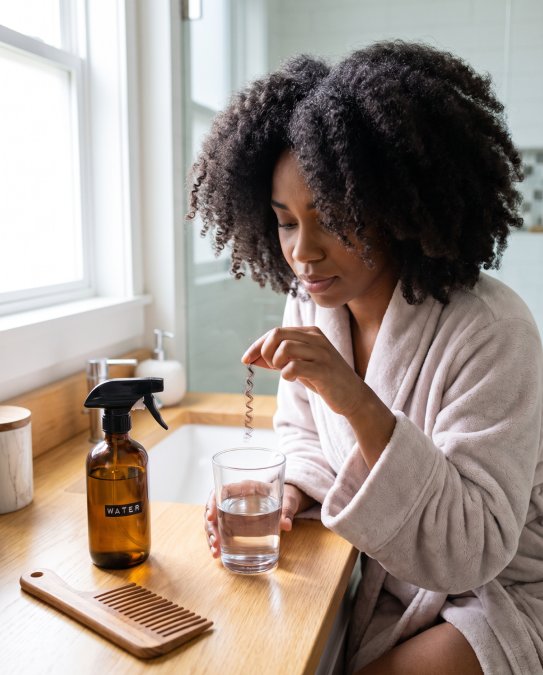
The Glass of Water Test (Float Test)
The glass of water test, also called the float test, is the most popular at-home porosity check. Drop a clean strand of shed hair into room-temperature water and wait two to four minutes. Floating near the top suggests low porosity; sinking slowly suggests medium; sinking fast suggests high.
The Slip and Slide Test
The slip and slide test checks how easily your fingers travel along a strand. Hold a single shed hair between your thumb and index finger and slide from the end toward your scalp. A bumpy, resistant slide points to raised cuticles and higher porosity. A smooth, almost frictionless slide points to a tightly sealed cuticle.
The Strand Stretch Test
The strand stretch test measures elasticity alongside porosity. Wet one strand and gently stretch it. Healthy hair stretches roughly a quarter of its length and springs back; hair that snaps quickly or stays stretched signals damage, which often accompanies high porosity (pubmed.ncbi.nlm.nih.gov).
The Visual Diagnostic: What Your Hair Looks Like Dry
Your dry hair tells you plenty before you touch water. Look for these visual cues:
- Low porosity: hair takes forever to get fully wet, products sit on top and feel greasy, strands look shiny but feel stiff
- High porosity: hair dries within minutes, looks dull or frizzy, feels rough when you run fingers down the strand
- Medium porosity: hair wets and dries at a normal pace, holds styles, feels smooth
Hair Porosity Float Test Accuracy: What Science Says
The float test is the most repeated piece of porosity advice online, and the least reliable.
Why a Strand Floats (and Why That Doesn't Mean Much)
A strand floats because of surface tension and trapped air, not because its cuticle is sealed. Three variables you cannot control at a bathroom sink determine the result:
- Surface tension: Room-temperature water holds a thin, lightweight strand aloft for minutes regardless of cuticle condition, a single strand is too light to break the surface film.
- Trapped air: The medulla, the porous core in thicker strands, holds air pockets. A wide medulla floats longer, and medulla size varies by genetics, not porosity.
- Product residue and oils: Silicones, butters, and sebum make strands hydrophobic. A conditioned low porosity strand and a buildup-covered high porosity strand can behave identically.
What Trichologists Actually Look At
Practitioners who assess hair clinically do not use a glass of water. They evaluate the cuticle directly:
- Wet feel and dry-down time: How long the full head takes to saturate and air-dry, a whole-head observation, not a single-strand one.
- Tensile behavior: How far a wet strand stretches before snapping, reflecting cortex and cuticle integrity.
- Light reflectance: A raised cuticle scatters light and reads dull; a flat cuticle reflects light and reads shiny.
- Absorption response: Whether a water-based product sinks in within seconds or beads on the surface.
The U.S. National Library of Medicine's research on hair fiber properties notes that cuticle condition and moisture retention vary along the length of a single strand, so any one-strand test, float, slip, or stretch, samples only a fraction of the picture.
A More Reliable At-Home Protocol
Instead of trusting one glass of water, run a three-signal check:
- Shower saturation: Under 30 seconds to feel fully wet points toward high porosity; over two minutes toward low.
- Air-dry time: Fast drying (under an hour for shoulder-length hair) suggests a raised cuticle; slow drying suggests a tight one.
- Product absorption: Apply a water-based leave-in to clean, damp hair. If it disappears, you lean high; if it sits on top and feels slick, you lean low.
When two or three signals agree, you have a working answer. When they conflict, your hair is likely medium or mixed porosity, common after partial chemical processing, where mid-lengths and ends behave differently from the roots.
Mixed Porosity: The Case Most Guides Ignore
Many people don't fit neatly into low, medium, or high. If your roots feel smooth and your ends rough, or the top dries fast while the back stays damp, you have mixed porosity. The fix is layered application: treat high-porosity sections (the oldest, most weathered ends) with sealing creams and protein, and low-porosity sections (near the root) with lightweight water-based moisture and heat. Section your hair and apply accordingly rather than smoothing one product from root to tip.
Signs of Low Porosity Hair and How to Care for It
Low porosity hair has a tightly closed cuticle that resists water and product absorption. Signs: hair floats in the float test, takes ages to saturate, and leave-ins sit on the surface rather than sink in.
A Low Porosity Hair Care Routine That Works
Heat is your ally. Warm water and a steamy shower open the cuticle enough for moisture to penetrate. Apply products to damp, not soaking, hair, and use lightweight, water-based formulas rather than heavy butters. Deep condition with heat, and avoid protein-heavy treatments that stiffen already-sealed strands.
Signs of High Porosity Hair and How to Care for It
High porosity hair has a cuticle whose scales are lifted, chipped, or missing. Moisture enters fast through the gaps and escapes just as fast. The result: hair that feels dry minutes after conditioning and frizzes the moment humidity rises.
Signs You Can Confirm Without a Glass of Water
- Hair dries within 30 to 60 minutes for shoulder-length hair
- Strands feel rough or bumpy sliding a finger from end toward root
- Hair looks dull, because a raised cuticle scatters light instead of reflecting it
- Ends feel straw-like and tangle easily, even after a fresh trim
- Color fades quickly after dyeing, because lifted cuticles leak pigment
- Hair feels brittle when wet and snaps before it stretches much
A common pattern is that high porosity shows up after a specific event: a bleach session, a relaxer, repeated flat-ironing, or years of sun and chlorine exposure. If your porosity changed suddenly, look for the chemical or heat trigger.
The Mechanism: Why Sealing Works
Because the cuticle cannot hold moisture on its own, high porosity hair needs an external barrier. The order matters:
- Water-based moisture first. Apply a leave-in conditioner or moisturizing cream to damp hair, the water your hair needs, which won't stay without the next step.
- Oil to slow evaporation. A lightweight oil (jojoba, grapeseed, or silicone-free) films the cuticle and slows water loss. Oils are sealants, not moisturizers.
- Butter or cream to close the gap. Shea, mango, and thick creams physically block moisture escape, the layer that makes the difference for high porosity hair.
Protein: Use It, Don't Overdo It
High porosity hair usually benefits from protein because the cuticle has gaps that hydrolyzed proteins temporarily fill. Look for hydrolyzed wheat, rice, or silk protein. But protein is a patch, not a cure, and overuse causes stiffness and snapping. Aim for one protein treatment every two to four weeks, alternating with moisture-focused deep conditioning. If hair feels hard or straw-like afterward, follow with a moisture mask and skip protein for a few weeks.
Technique Changes That Matter More Than Products
- Wash less often. Every wash strips the little moisture high porosity hair holds. Two to three times a week is a reasonable target.
- Skip hot water. Heat lifts the cuticle further. Lukewarm for washing, cool for the final rinse.
- Apply products in the shower. Hair absorbs best while wet and the cuticle is most pliable.
- Use a microfiber towel or cotton T-shirt. Terry cloth roughens an already-raised cuticle.
- Sleep on satin or silk. Cotton pillowcases wick moisture out overnight.
The Climate Variable Most Guides Skip
High porosity hair reacts to dew point, not just humidity percentage. Above roughly 60°F, humectants like glycerin pull moisture into your hair, great for high porosity hair that needs it. Below about 50°F, those same humectants pull moisture out into the dry air, making hair feel drier. In low-dew-point conditions, swap glycerin-heavy products for sealing oils and butters; in high-dew-point conditions, humectants are your best friend. Checking the dew point before styling is a five-second habit that prevents bad hair days.
Condition |
Dew Point |
What to Reach For |
|---|---|---|
Dry, cold air |
Below 50°F |
Butters, sealing oils, no glycerin |
Moderate |
50-60°F |
Balanced cream, light glycerin |
Humid |
Above 60°F |
Humectants, water-based leave-ins |
When to Consider a Bond Builder
For high porosity hair caused by chemical or heat damage, bond builders targeting disulfide bonds in the cortex can restore some structural integrity over time. They are not moisturizers or protein, they work on a different layer. They are most useful in the weeks right after a damaging service, when the cuticle is most compromised. Expect gradual improvement over several applications, not an overnight fix.
Best Products for Natural Hair Porosity
The best products for natural hair porosity match how your cuticle behaves, not your curl type. Low porosity hair needs water-based leave-ins and humectants that draw moisture in without weighing strands down; high porosity hair needs heavier creams, butters, and sealing oils that lock moisture in. Kinkistry's HydraLuxe line was built on this principle, with a Gentle Refining Shampoo, EXTREME Moisturizing Conditioner, and MEGA Moisture Leave-In Conditioner designed to support moisture retention across porosity levels. If you're unsure which texture matches your hair, the Certified Texture Match service takes the guesswork out of it.

How Porosity Changes Over Time and With the Seasons
Porosity is not fixed. Chemical processing, bleaching, dyeing, and heat damage raise the cuticle over time, pushing hair toward higher porosity. Dry winter air accelerates moisture loss, while humid summers make low porosity hair feel heavy and coated, a routine that worked in July may fail by January. Re-test your porosity once or twice a year, and after any major chemical service, so your products keep pace with your hair's actual condition.
Frequently Asked Questions
Is it better to have high or low porosity hair?
Neither porosity level is inherently better; each just needs different care. Low porosity hair resists moisture because the cuticle lies flat, so it needs lightweight products and gentle heat to open the cuticle. High porosity hair absorbs moisture quickly but loses it just as fast due to raised cuticles, so it benefits from heavier creams, leave-in treatments, and sealing oils. The goal is to work with your porosity, not against it.
What are the signs of low porosity hair?
Low porosity hair often feels smooth and takes a long time to get fully wet in the shower. Products tend to sit on top of the hair rather than soaking in, and you may notice buildup or white residue from styling products. Hair also takes longer to air-dry. If your strands feel dense and resist absorbing water, you likely have low porosity.
Does hair porosity change over time?
Yes, porosity can shift due to chemical processing, heat damage, and environmental stressors. Bleaching, dyeing, and frequent high-heat styling can raise the cuticle, turning low porosity hair into high porosity over months or years. Age and cumulative sun exposure also play a role. It's worth retesting your porosity every six to twelve months, especially after a big change in your routine.
How can I tell if my hair is high or low porosity?
Try the glass of water test: place a clean strand in room-temperature water for 2-4 minutes. If it floats, you likely have low porosity; if it sinks, high porosity. For a more reliable read, combine this with the slip and slide test (run fingers up a strand; bumpy means high porosity) and the visual check (frizzy, dull, or rough-feeling hair often signals high porosity).